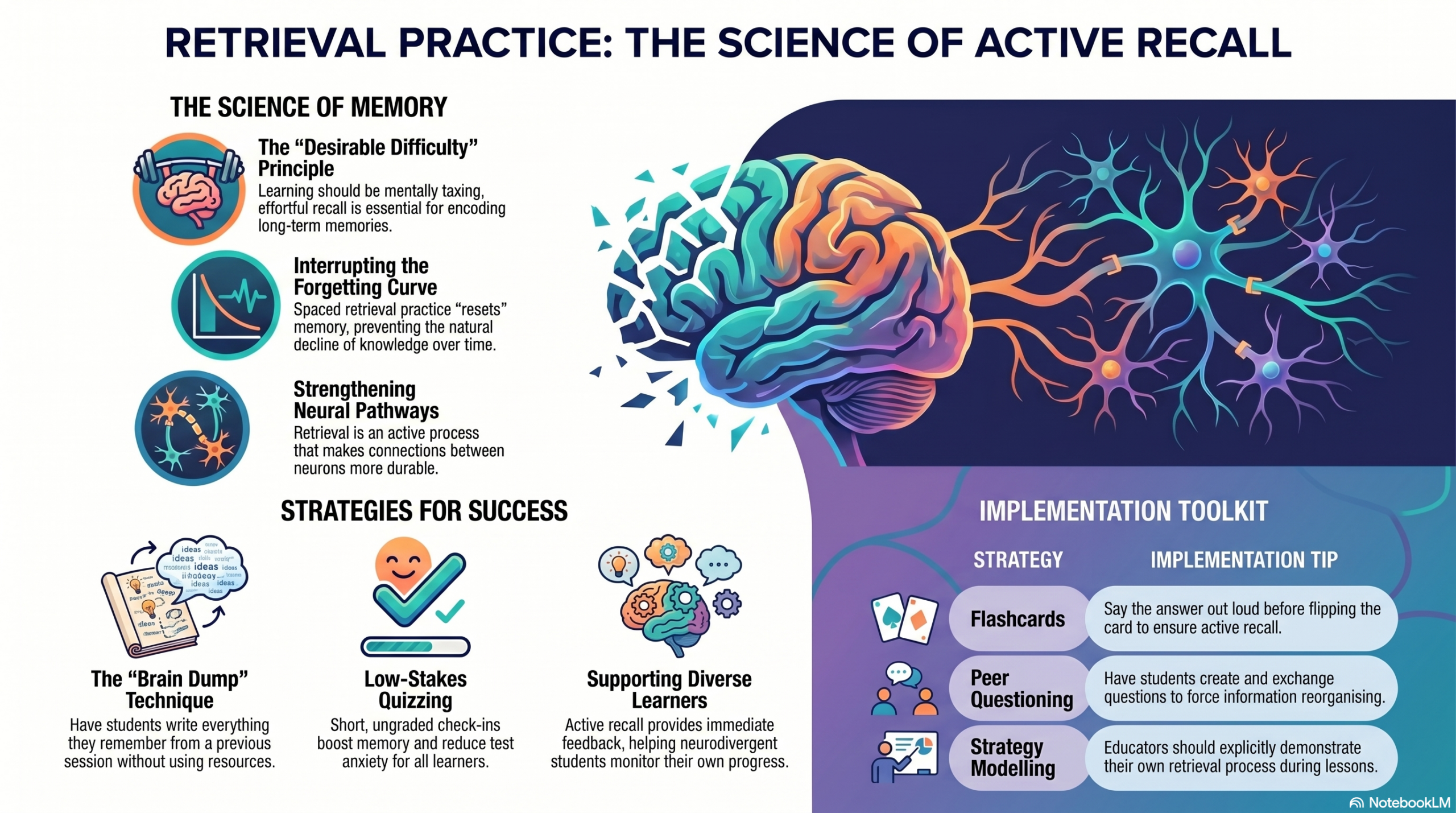
Retrieval practice is the act of intentionally recalling information from memory, which research shows is far more effective for long-term retention than passive reviewing or re-reading. By forcing the brain to “reconstruct” knowledge, you strengthen neural pathways and make information easier to access in the future.
1. The Mechanism of Memory
When you retrieve information, you aren’t just “finding” a stored file; you are actively strengthening the connection between neurons, a process that makes the memory more durable each time it occurs.
- The “Desirable Difficulty” Principle: Learning should be mentally taxing. If it feels too easy—like simply re-reading notes—the brain isn’t doing the work required to encode the memory.
- The Forgetting Curve: We naturally forget information over time. Retrieval practice at intervals (spaced practice) interrupts this decline and “resets” the memory, keeping it fresh.
2. Practical Classroom Strategies
| Strategy | Implementation Tip |
| Brain Dumps | At the start of a session, have students write down everything they remember from the previous class without looking at resources. |
| Low-Stakes Quizzing | Use short, ungraded “check-ins” to practice recalling key concepts; this reduces test anxiety while boosting memory. |
| Flashcard Systems | Encourage students to use active recall methods rather than passive sorting, such as saying the answer out loud before flipping the card. |
| Peer Questioning | Have students create and exchange questions based on the lecture, which forces them to retrieve and re-organize the information to teach it. |
3. Supporting Diverse Learners
Retrieval practice provides a structured, predictable way for all students to monitor their own learning.
- Self-Monitoring for Neurodivergence: Students with ADHD or executive functioning challenges often struggle to know what they “don’t know”. Retrieval practice provides immediate, concrete feedback on what has been mastered and what requires more study.
- Reduced Overwhelm: Instead of trying to “study everything,” retrieval practice allows students to focus on specific, manageable “chunks” of information during each session.
- Building Confidence: By successfully recalling information, students develop a sense of self-efficacy, helping them see that their brain is capable of growth through active effort.
4. Moving Toward “Active” Studying
Educators should explicitly teach students how to use retrieval practice, as many default to ineffective passive strategies.
- Model the Strategy: Explicitly show students that you are engaging in retrieval practice during class (e.g., “I’m going to pause and try to recall what we defined as ‘scaffolding’ before I check my notes”).
- Focus on Accuracy, Not Speed: Encourage students to take their time during retrieval. The benefit comes from the mental effort, not from answering as quickly as possible.
- Normalize “Retrieval Failure”: Remind students that when they can’t remember something, it’s not a failure; it’s a signal that the brain needs more support and that the next attempt to retrieve it will be even more effective for learning.
Reflection
Retrieval practice turns the act of studying from a passive consumption of content into an active, productive struggle. In your courses, what is one “key term” you could ask your students to recall at the start of the next hour to help them solidify their learning?